Challenges and Opportunities for the Black Earth Electric Utility
The Village of Black Earth owns its electric utility--Black Earth Electric (BEE). BEE began providing electricity to Village customers in 1914. With the help of the federal government’s Rural Electrification Administration established in 1937, BEE extended its service gradually to rural areas, eventually building about 86 miles of its own grid distribution lines in rural areas surrounding the Village of Black Earth. There are presently 896 customers of BEE within the Village boundaries. Outside of the Village boundaries, there are around 500 customers or about 36% of total customers. About 174 of those rural customers are in Vermont Township. The remaining 326 rural customers are in Black Earth, Mazomanie and Berry Townships.
My experiences as a customer of BEE have been positive as have been those of my neighbors.
There are COVID related challenges, however, as well as opportunities.
Alliant Energy (aka Wisconsin Power and Light) sells electricity to BEE at a Municipal Utility rate, which it then provides to its customers. The cost of that electricity from Alliant plus the cost of maintaining its grid has to be covered from revenues generated from sales of electricity to its 1,400 customers. If revenues exceed costs in any given year, the excess is deposited in a Surplus Fund for use in emergencies or for helping finance capital improvements. If there is a loss in a particular year due to costs exceeding revenues, then the Surplus Fund covers the deficit.
The Villages of Black Earth and Mazomanie in 2000 decided to keep the maintenance costs of their two small municipal utilities relatively low by hiring a single company, Vanguard Electric, to perform work pertaining to the construction and maintenance of power lines and substations owned by the two Villages.
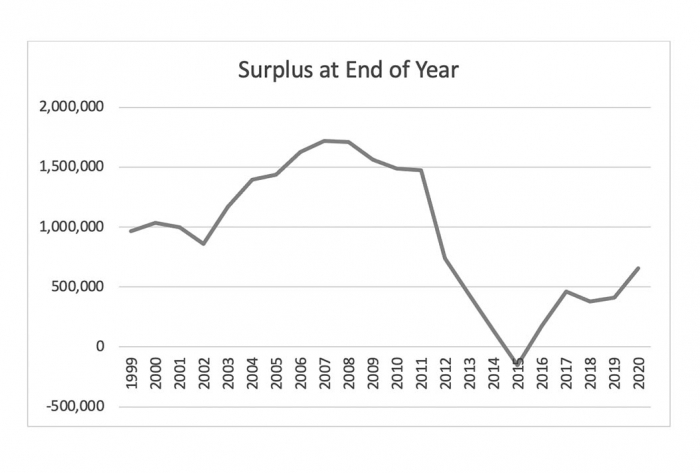
Financially, things seemed to be going well for BEE for several years. Between the years 1999 and 2008, only in 2002 and in 2005 did expenses just slightly exceed revenues. Mostly revenues exceeded expenses at an acceptable margin. The chart shows that during the years 2003 through 2008, the utility had maintained a healthy Surplus Fund of at least $1.5 million.
However, beginning in 2009 through 2018 expenses exceeded revenues every year, sometimes substantially, with accumulated losses for those 10 years totaling $1,960,564.
In 2013 a massive embezzlement of at least $407,371 was discovered during the period from 2009 to 2012 from various Village accounts, including from its electric utility.
Although the Village recovered some of the lost funds from insurance, and the person involved was able to repay a substantial amount, from newspaper reports the Village was stuck with a $170,000 loss.
Adding to the financial crisis from the embezzlement was an order by the Public Service Commission in 2013, the same year that the embezzlement was discovered, for BEE to repay the Wisconsin Heights School District for mistaken overcharges in previous years, amounting to $309,342.
By the end of 2015 the Surplus Fund had been totally depleted and was actually negative.
The PSC approved a rate increase in 2014 and another in 2019. In 2017 by reclassifying allocations in the yearly accounting reports, over $400,000 was added to the surplus fund which enabled that fund to stay positive for that and subsequent years, but just barely. In that same year the Village had to take out a substantial loan in large part to cover losses in its electric and sewage utilities.
In 2019 the surplus fund grew again by a modest amount.
Then COVID hit in March of 2020. There were fears that BEE would suffer a net loss again. However, the declining use of electricity and a 16% decline in the price of electricity from Alliant actually resulted in increased revenues relative to in 2020. The happy result was a surplus of $115,838 for 2020, which produced a total unallocated surplus fund of $653,983 at the end of 2020.
While certainly an achievement, the level of the Surplus Fund presently is less than half what it had been prior to the crisis of the late 2000’s. In those days the surplus would cover bad years and major parts of capital investments which might become necessary.
While BEE has faced serious challenges during the past 20 years, the improvement of its financial situation the past two years means that the utility can with greater confidence address challenges.
The Village has recently decided to install a second substation.